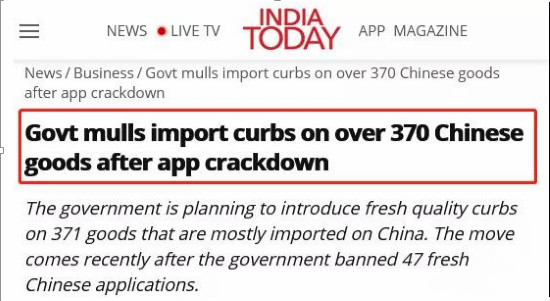
On September 28, according to "India Today" media reports: After targeting the suppression of Chinese apps, the Indian government is considering imposing import restrictions on more than 370 Chinese products.
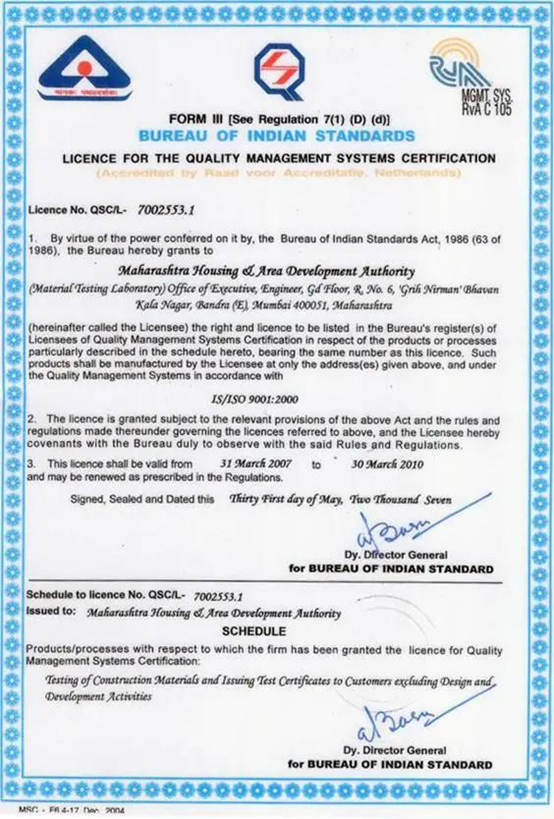
This is after India announced in April this year that it will implement BIS compulsory certification inspections for 12 major products including lighting, keyboards, Bluetooth headsets, USB external hard drives, induction cookers, rice cookers, etc. from October 1st. It will be fully implemented before March next year.
India Report
According to the media report, the government is considering imposing import restrictions on various commodities mainly imported from China. According to a report published by The Times of India, toys, steel pipes, steel bars, consumer electronics, telecommunications products, heavy machinery, paper, rubber (11070, 325.00, 3.02%) products and glass (1682, 3.00, 0.18%) Other items will be included in India's mandatory standards (BIS) system next year.
From March 2021, many non-compliant and non-essential imports will begin to be restricted. Consumer Affairs Minister Ram Vilas Paswan said that after the Bureau of Standards of India prepares the Ministry of Commerce's regulations on high-quality imported products, many substandard and non-essential imported products will stop importing from March 2021, and BIS will start in 2021. Established mandatory certification standards for 371 product projects a month ago.
According to the report, these 371 tax items include multiple sub-sectors, from steel, chemicals, pharmaceuticals, electrical machinery to furniture and toys. BIS Director General Pramod Kumar Tiwari further stated: The Indian Ministry of Commerce has determined tariffs on 371 commodities, including Chinese commodities. We are working hard to speed up the establishment of these mandatory standards to strengthen import requirements and improve the enforcement of all government-owned ports including Kandla, JNPT and Cochin. BIS will send relevant personnel to carry out on-site inspection of the goods at the port together with customs personnel. At the same time, strict inspections are performed on the product packaging such as the country of origin identification, production date, and product expiration date.
Tiwari added that the mandatory certification standards for most products will be formulated before December, and the time for the remaining products will be formulated before March 2021.
According to the report, the measure will suspend the import of substandard products. It is worth noting that the Ministry of Commerce has identified these products last year, and some officials said that according to the "Atmanirbhar Bharat" initiative, the procedures for implementing restrictions on imports have been accelerated. According to this initiative, India plans to reduce unnecessary imports and increase exports.
"Atmanirbhar Bharat" is actually an upgraded version of the Indian manufacturing plan. Through economic development, it helps small, medium and micro enterprises, promotes infrastructure construction, improves the business environment, and realizes self-reliance driven by technology. Its main purpose is to reduce imports and expand exports. In order to realize the so-called "Made in India" dream of a big country, India has been struggling.
According to the media, although the Indian government's purpose in doing so is to eliminate imports that do not meet the standards, the move seems to be to reduce imports from China as much as possible. Not only Chinese products, the government is also suppressing many Chinese BIS certification applications.
About BIS certification
What is BIS certification?
BIS certification is the ISI certification authority, The Bureau of Indian Standards (The Bureau of Indian Standards), referred to as BIS, which is specifically responsible for product certification and is also the only product certification body in India. Currently, the certification covers almost every industrial field such as agricultural products, textiles, and electronics. BIS certification is carried out in accordance with the "Indian Bureau of Standards Act 1986" and aims to provide end consumers with quality-assured, safe and reliable products. All products listed in compulsory certification must be tested in a laboratory accredited by the local BIS in India in accordance with IS 14286, IS 61730-I, and IS 61730-II standards.
The Bureau of Indian Standards (The Bureau of Indian Standards), referred to as BIS. BIS is the competent authority for Indian standards and certification affairs.
(1) BIS certification model
BIS product certification determines whether the product is consistent with the Indian standard through the initial inspection and evaluation of the factory quality management system, the supervision of the factory quality management system after certification, and the testing of samples taken from the factory and the market.
(2) BIS certification conditions:
The manufacturer establishes an office or liaison organization or appoints an agent in India; the manufacturer's factory must be equipped with all the infrastructure for testing and applying for approval of products that meet the relevant Indian standards.
(3) The technical documents to be submitted for BIS certification are as follows:
Application form (appointment form certifying that there is an agent in India, or a certification document certifying the Indian office of the manufacturer, and a permit from the Reserve Bank of India);
Documents certifying the establishment of the company, such as a registration certificate;
Process flow chart, explaining the whole process of product manufacturing, (from raw materials to finished products);
Quality control system (such as quality manual, quality control plan, test arrangement, etc.);
If so (provide other detailed information of the product or system certification, and provide detailed information of the components or raw materials used for product manufacturing before certification);
List of manufactured machines;
List of test equipment during the test;
Product design drawing;
Detailed details of the qualification certificates and experience of the laboratory supervisor, technical and QC staff;
Test report from an accredited independent laboratory or the factory’s own laboratory;
Schematic diagram of the layout of the plant, clearly showing the main production machines, laboratories, etc.;
The traffic diagram near the factory, the diagram from the nearest airport or railway station to the factory, and the detailed instructions from India to the factory;
Bill of exchange
(4) India BIS certification scope:
1. Textiles
2. Chemicals and pesticides
3. Rubber and plastic products
4. Cement and concrete products
5. Building Materials
6. Pumping, irrigation, drainage and sewage treatment equipment
7. Piping and installations of water supply system
8. Basic metals and processed metal products
9. Machinery and equipment
10. Electronic appliances and optical equipment
11. Auto parts
12. Agricultural products, food and tobacco
13. Black tea and beverages
14. Packaging drinking water and natural mineral water
15. Leather products
16. Wood products
17. Pulp products
(Incomplete, for reference only)
(5) Certification process:
1. Apply. Foreign manufacturers who want to obtain BIS certification generally need to use a special application form and prepare relevant documents to apply to the BIS New Delhi headquarters.
2. Record. BIS reviews the application documents and materials submitted by the applicant, and records the application if the procedures are complete. Applicants must pay corresponding processing fees.
3. Initial factory inspection. BIS will assign a delegation of no more than 2 officials to the factory for inspection. Applicants shall bear the expenses of travel and visa fees of the official delegation to the factory for inspection and corresponding inspection expenses.
4. Issuing certificates. If the initial inspection and test results are qualified, and the applicant agrees to implement the BIS-approved inspection and test plan after certification and pay the BIS identification fee, the applicant can be issued a certificate. The certificate is valid for 1 year. After the certificate is granted, the certificate holder must pay the identification fee and the annual certificate fee every year.
5. Supervision after certification. BIS supervises the quality of its certified products through regular supervision of witnesses and surprise inspections and tests on samples in factories and markets. If it is checked regularly and the samples taken from the factory or the market meet the requirements after the factory inspection and independent test results, the certificate can be updated. The certificate holder submits an application for renewal to BIS by submitting the designated form. The certificate renewal fee is 500 rupees. The licensee must also bear the cost of sample inspection.
India BIS certificate